
Underwrite cyber with leading cyber risk analytics
Partnering with leading institutions to power their growth
The Client Perspective: Guy Carpenter - Michael Horner
The Client Perspective: MS Amlin - Jonathan Kimber
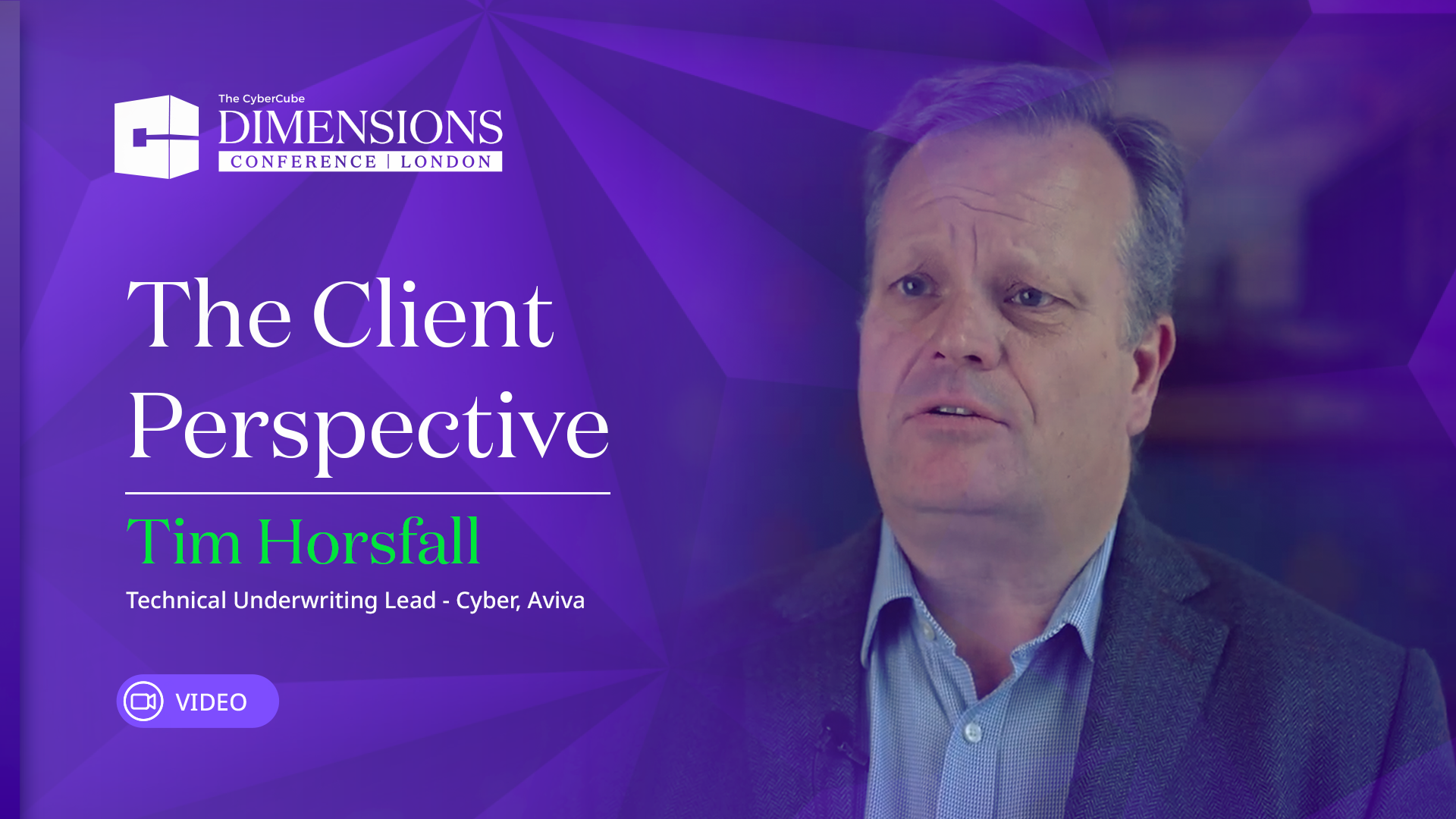
The Client Perspective: Aviva - Tim Horsfall
You & CyberCube
Transforming cyber insights into sustainable profits with the industry's most advanced suite of analytics
CyberCube is able to identify Single Points of Failure (SPoFs) within portfolios and manage your risk concentrations to help minimize cyber catastrophe losses across all coverage types.
Capability overview
- View technology dependencies in your portfolio
- Understand and manage your digital supply chain risk accumulations
- Improve claims response to cyber events.

A whole suite of out-of-box capabilities:
- Financial loss quantification
- Predictive risk factor benchmarking
- Predictive security and exposure scores
- Past cyber incidents
- Technology dependency data
- Cyber risk mitigation recommendations
The industry's most advanced suite of analytics for first-party cyber
As well as a unique view of each single risk with claims-validated predictive analytics, our cross-suite of software tools can be powered up and customised exactly to your specifications to quantify financial loss. Delivered as a standalone solution, or integrated seamlessly in your existing workflows via an API, you won't need to step out of your underwriting workflow
Automate and streamline your unique workflows
Purpose built from the ground up for insurance underwriters and reinsurance workflows, CyberCube’s data approach enables you to surface the key predictive insights you need to make data-driven risk selections and pricing decisions, with your own guidelines and view of risk respected.
Custom solutions. Custom analytics.
Create the ultimate suite of analytics for your own personalised view of cyber risk with cyber underwriting and portfolio risk management tools
Solutions
Account Manager
- Make data-driven underwriting risk selection and pricing decisions
- Filter out the noise and contextualize key risk and loss data
- Quickly identify the accounts that fall within your underwriting guidelines
- Assess the impact of a single risk on a portfolio (Marginal Risk Module with AM + PM)
- Integrate Account Manager analytics into underwriting workflows with CyberConnect APIs
Portfolio Manager
Make informed decisions
- Access the broadest array of realistic scenarios available in the industry for a transparent, industry-validated assessment of your portfolio risk
- Analyze your silent cyber risk across all lines of business
- Probabilistically quantify aggregation and attritional losses
- establish risk appetite
- optimize portfolios
- forecast performance
- Refine analysis options with controls to adjust frequency, severity, and other assumptions
Establish your own view of risk
- Stress test scenarios against your own portfolio(s) to develop and represent your company’s own robust, realistic and validated view of risk
- Uncover portfolio-level insights for your senior leadership and working teams
- Refine your organization’s risk management strategies
- Determine optimal pricing
Exposure Manager
Exposure Manager establishes a new industry standard for assessing portfolio health, blending firmographic, technographic, and policy data into a unified view. This empowers (re)insurers to make faster, smarter capital and underwriting decisions. Learn More

Broking Manager
With engagement in across 100+ markets worldwide, Broking Manager helps brokers effectively communicate cyber risk to clients and illustrates the financial exposure and benchmarking details needed to substantiate cyber insurance recommendations. Brokers can better:
- Quantify cyber loss potential
- Inform insurance limits
- Identify exposures
- Streamline team workflows
- Benchmark risk strategies with peers
- Refine modeled losses with company assessments
With a more analytics-driven advisory process, brokers increase their value by becoming more effective advisors in today’s cyber insurance marketplace.
Learn MoreSPoF Intelligence
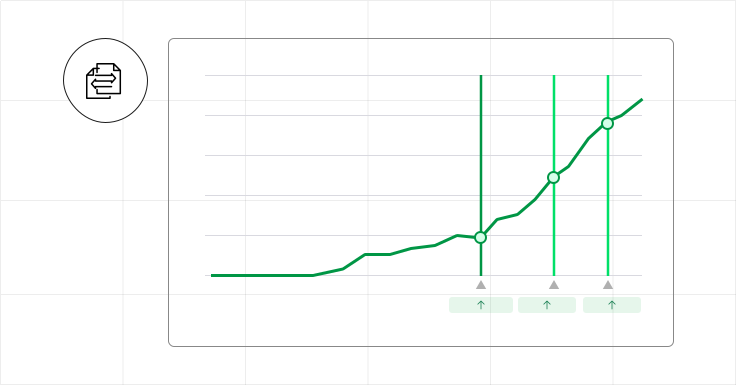
- View technology dependencies in your portfolios
- Understand any risk's digital supply chain risk concentrations
- Improve claims response to cyber events
- Manage cyber accumulations
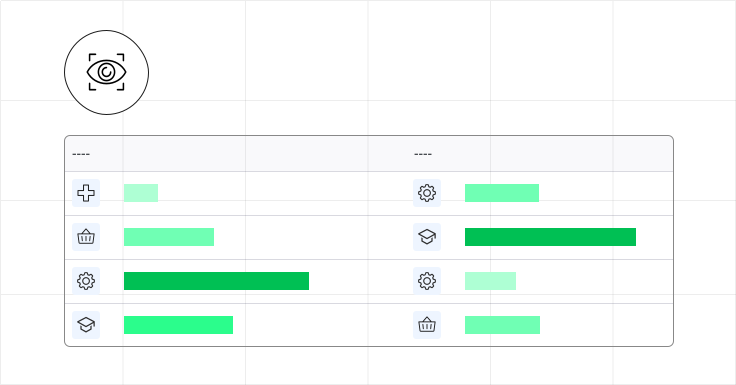
Industry Exposure Databases
- Analyze potential growth strategies
- Perform real-time event analyses and sensitivity analyses
- Create proxy portfolios for planning purposes
- Validate models and manage model changes
- Conduct industry benchmarking analysis
Why our clients choose CyberCube
Testimonials
Stephen Ridley
Head of Cyber
Aviva selected CyberCube "to help us grow our cyber book in a sustainable and profitable manner - but it will also play an important role in helping our customers improve their security capabilities and mitigate risks before they become an issue. Furthermore, CyberCube's risk selection expertise will help us ensure that we have a strong grip on. our potential exposure to systemic cyber risks."
Adam Braithwaite
Senior Reinsurance Actuary

Lockton Re selected Portfolio Manager to "integrate with Locton Re's SAGE, our proprietary reinsurance analytics platform, to provide our clients with even greater analytical insights and advice for their cyber portfolios."
sdfgsdfg
sdfgsdfg
dsfgsdfgsdfg
dfgsdfgsdf
gsdfgsdfgsd
fgsdfgsdfgsdfg

How do we help?
How do we help?
-
The SME cyber risk sector is competitive and efficiency is key to success. As an underwriter, you need to be able to select the best risks for your portfolio, while maintaining discipline and following an efficient process. Account Manager combines a large number of data sources — from internal and external security data, historical losses and enterprise data — and applies specialized analytics to produce targeted information on an SME’s cyber risk profile.
With Account Manager, automated processes can instantly access reports on millions of companies globally to rapidly triage and filter for risk quality. Security and Exposure Scores allow for easy insertion into underwriting guidelines and worksheets. Additional data signals determine known technology dependencies to identify potentially critical third party relationships. These scores also allow for easy identification of potentially risky behaviors or processes to identify outsized loss contributors before binding.
-
When faced with underwriting individual large risks, underwriters need to be able to sift through significant volumes of information. Provided by various stakeholders within a prospective organization, that information may be incomplete, irrelevant or more technical than is easily digestible. These accounts may be requesting large limits or highly tailored policies while also having potentially extensive third-party liability, as well as complex supply chains and relationship networks. There is also the ever-present threat of an unexpected accumulation event. How, then, can you use data-driven analytics to make better, more educated decisions based on a consistent approach to risk tolerance?
Account Manager delivers curated, predictive signals from a large number of data sources — including internal and external security data, historical losses and enterprise data — and applies specialized analytics to produce targeted information on an organization’s cyber risk profile. It provides a summarized view of the most insurance-relevant risk factors the underwriter needs to focus on, which have been calibrated and validated against real claims and incident data.
With Account Manager, every underwriter has instant access to global reports on millions of companies to rapidly triage and filter risk quality. Security and Exposure scores allow for easy insertion into underwriting guidelines and worksheets. Additional data signals determine known technology dependencies to identify potentially critical third party relationships. These scores also allow for easy identification of potentially risky behaviors or processes that require further discussion with the account.
-
How do I set risk tolerance thresholds and inform reinsurance purchases?
Building a forward-looking view of risk to manage portfolio accumulations and set risk tolerance thresholds is a complex and resource-intensive task. Understanding exposure in your portfolio to inform risk appetite, capital allocation and risk transfer strategies are key to building a sustainable portfolio enables portfolio managers to create actionable, insightful management information with an acceptable level of certainty.
CyberCube’s Portfolio Manager is a scenario-based data-driven model that enables risk managers to develop portfolio-level insights for their senior leadership and their working teams. With PM, you can:
- Quickly access visualizations on exceedance probability metrics to include in management information packs.
- Drill down and identify loss drivers and areas of accumulation risk.
- Dive into more granular details by scenario, risk class, and account level statistics.


-
Carriers are increasingly motivated to proactively consider where cyber exposure may occur across multiple lines of business. How can carriers set loss reserves and forecast capital requirements for cyber risk allocate loss reserves for the development profile of potential incidents? For insurers, scenario-based modeling is the route forward.
CyberCube’s Portfolio Manager model can run ‘what-if’ analyses on exposures to assess risk exposure across classes and determine appropriate action. CyberCube’s multi-line approach enables a broader view across the spectrum of P&C risks, including aviation, marine, product liability, offshore energy, and kidnap and ransom. A key area of focus is multi-line accumulation, as a systemic cyber event might result in losses, for example, under both D&O and product liability covers.
-
The fast-changing nature of cyber risk creates increased uncertainty for risk modelers and portfolio managers trying to identify portfolio exposure accumulations and develop realistic cyber catastrophe scenarios. Risk modelers need the flexibility to vary frequency, severity and other assumptions to dynamically stress test model outputs. Portfolio managers can efficiently stress test their assumptions using CyberCube’s models alone, and/or layer in their own view of risk.
CyberCube’s Portfolio Manager lets you build your own view of risk by enabling the transparency and controls necessary to stress-test varying frequency distributions, frequency modes, and severity modes. Portfolio Manager allows you to drill down and identify loss drivers and areas of accumulation risk across multiple lines of business.
Related Insights
- Nate Brink
3 Ways Cyber Risk Analytics Strengthen Client Retention
- Jon Choi
When the Model Goes Dark: AI Dependency and Cyber Resilience

- The CyberCube Team
When Does a Data Refresh Become a Model Change?
- The CyberCube Team
Machine State of Mind: What AI Actually Means for Insurance Risk
- William Altman
FortiBleed: What Credential Harvesting Means for Cyber (Re)Insurers
- Richard Ford
What Data Drift Means for Cyber Insurance Models
- Nate Brink
India’s DPDPA: How Regulatory Change Is Reshaping Cyber Risk
- Richard Ford