









Skip to content

Capabilities

Industry-proven analytics

Cyber (re)insurers achieve sustainable growth using CyberCube’s portfolio insights with detailed modeling, analysis and reporting capabilities for all stakeholders.

Pricing analytics

Establish cyber risk specific technical pricing fundamentals across both attritional and catastrophic cyber losses

Exposure-based modeling to complement more experience-based, in-house models

Total portfolio loss analytics for evaluating reinsurance needs

Exposure Management

Gain insight into what type of exposure is driving cyber risk at different points on the loss distribution

Quantify cyber risk levels and the correlation in cyber risk across policies

Identify the most viable exposure management strategies by rapidly modeling the impact of various alternatives

Establish your view of risk

Transparent modeling framework allowing for ease of understanding model loss drivers for both attritional and catastrophic cyber perils

Flexible model settings and output allow implementation of your view of risk

Access to the deepest bench of cyber risk and insurance professionals to establish valid programs 

(Re)insurance product innovation

Flexibly analyze relationships between coverages

Adjust to better reflect the risks that are covered against modeled scenarios

Conduct sensitivity testing of potential product changes with probabilistic scenarios

Explainable and tangible cyber scenarios

20 cost components

Continually updated policy modeling capabilities to reflect market needs

Full loss perspective with industry-leading attritional and catastrophic modeling

Most predictive power to differentiate high risks from low

Conduct comprehensive analyses for informed risk transfer decisions

Meaningful portfolio differentiation

Discover how to leverage leading cyber risk analytics for your business

Book a demo

Partnering with leading institutions to power their growth

data-analytics-presentation

Using data-driven analytics to stay ahead

Cyber risk is in a state of constant flux. (Re)insurers need a comprehensive solution that, by design, stays ahead of those trends to ensure your organization is accounting for both potential mass accumulation events and attritional events.

CyberCube understands the challenges cyber risk poses and has developed the market’s leading cyber portfolio modeling solution, Portfolio Manager (PM). PM ensures you can obtain a robust, realistic, and validated view of potential financial loss.

What Portfolio Manager delivers

Features

Detailed reporting
Quantify and segment risk and exposure across key dimensions, as well as granular loss results to illustrate risk breakdowns for virtually any stakeholder.
Robust threat landscape intelligence
Access the broadest, most detailed catalog of cyber perils for a reliable, defensible assessment of your risk.
Refined analysis control options
Dynamically stress test model outputs and establish your own view of the risk using analysis controls to adjust frequency, severity and other assumptions.
Comprehensive financial modeling
Leverage best-in-class cyber catastrophe and predictive attritional models to understand your financial loss potential. Utilize company-specific security telemetry and firmographics to help shape portfolio strategy and enable quantified feedback to underwriting teams.
Multi-line cyber modeling
Assess cyber exposure across all P&C lines of business. Isolate loss cost components to reflect potential cyber perils for both affirmative and non-affirmative cyber.
CyberConnect APIs for more power
Integrating Portfolio Manager capabilities via CyberConnect provides power users with access to company level YLT for full control of your analyses.

Cross-suite capabilities

Related solutions

SPoF Intelligence

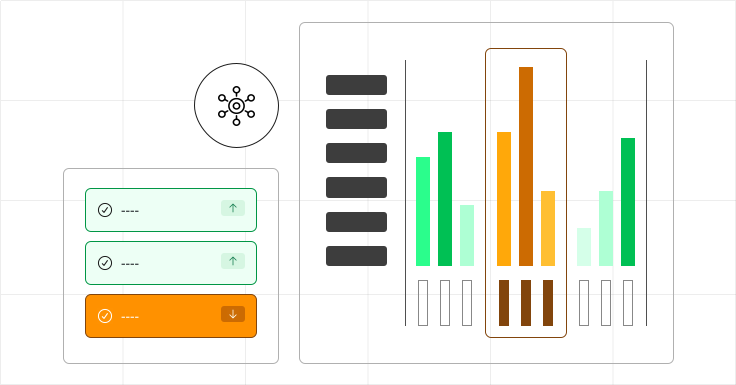
Identify Single Points of Failure (SPoFs) within portfolios and manage your risk concentrations to help minimize cyber catastrophe losses across all coverage types.

Capability overview

  • View technology dependencies in your portfolio
  • Understand and manage your digital supply chain risk accumulations
  • Improve claims response to cyber events.
Learn More
spof-intelligence

Industry Exposure Database (IED)

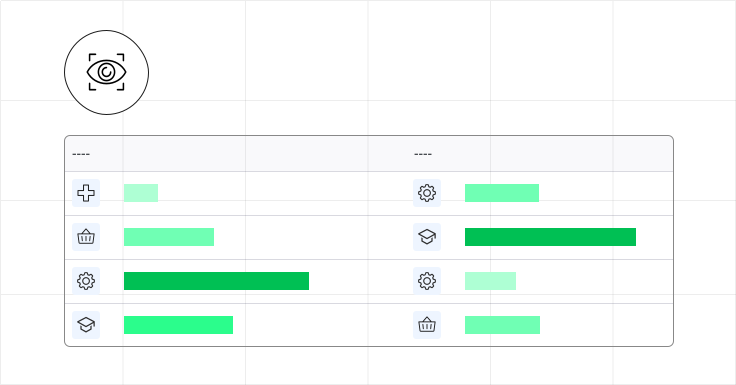
CyberCube’s Industry Exposure Databases (IEDs) are the world’s first set of detailed cyber-exposure databases, providing foundations for the only industry-accepted industry loss curves.

Capability overview

  • Analyze potential growth strategies
  • Perform real-time event analyses and sensitivity analyses
  • Create proxy portfolios for planning purposes, reinsurance, or ILS transactions
  • Validate models and manage model changes and conduct industry benchmarking analysis
Learn More
industry-exposure-database

Unlock insights with Account Manager integration

  • Underwriters can quickly quantify and understand an individual account’s impact on the portfolio with:

    • CAT load metrics
    • Tail diversification measurements
    • Return-on-risk capital thresholds
  • Analyze and quantify the risk quality of any portfolio to distinguish one from another for portfolio optimization and risk monitoring. Dissect your portfolio and identify problem accounts, industries, and peer groups based on select at-risk telemetry.

    • Identify the key drivers of risk and profitability within your portfolio
    • Generate a custom view of accounts and their ranks within your portfolio*
    • Easily generate portfolio optimization analyses for annual tiering exercises
    • Demonstrate underwriting discipline and rigor for reinsurance discussions
Portrait-of-confident-woman-in-engineering-role

Learn more about how Portfolio Manager can integrate into your workflows with strategic technology partnerships.

Strategic Tech Ecosystem

Why our clients choose CyberCube

swipe
drag

Stefan Golling

Member of the Board of Management

Leveraging the capabilities of CyberCube will help our underwriting and risk modelling teams in better quantifying cyber risk and understanding potential cyber accumulation scenarios.

Claude Yoder

Global Chief Innovation and Product Development Officer

The powerful combination of our knowledge of (re)insurance dynamics and the evolution of the product and macro-systemic industry concerns — coupled with CyberCube’s expertise in data science, cyber security, software engineering and actuarial modeling — will deepen the industry’s understanding of this rapidly evolving risk.

Adam Braithwaite

Senior Reinsurance Actuary

Lockton Re selected Portfolio Manager to "integrate with Lockton Re's SAGE, our proprietary reinsurance analytics platform, to provide our clients with even greater analytical insights and advice for their cyber portfolios."

Frequently Asked Questions (FAQs)

  • Portfolio Manager is built for the teams that make cyber portfolio, capital, and risk transfer decisions across the cyber insurance ecosystem. Primary insurers can use it for risk appetite, portfolio steering, reinsurance purchase, reserving, and board reporting. Reinsurers can use it for cedant benchmarking, treaty comparison, retrocession planning, and aggregation management as an input to treaty pricing. Reinsurance brokers can use it to support program design, placement discussions, loss-driver explanation, and capital markets conversations. MGAs, captives, ILS funds, and capital providers can use it to evaluate risk quality and test participation strategies. The common value is a consistent, financially grounded view of cyber portfolio risk.

  • Portfolio Manager ingests policy-level portfolio data, company context, technology dependencies, and insurance terms, then applies probabilistic cyber catastrophe and attritional loss modeling to estimate insured financial loss. Teams can analyze loss distributions, exceedance probability metrics, contribution views, and detailed event loss outputs by scenario, coverage, industry, geography, company size, or custom segment. This gives insurers, reinsurers, brokers, and capital providers a clearer view of expected loss, tail risk, and the events most likely to drive volatility. The business value is more defensible portfolio risk management, stronger capital planning, and better-informed decisions about underwriting, pricing, reinsurance, and growth.

  • Portfolio Manager helps teams identify cyber accumulation risk by connecting insured exposures to shared technologies, industries, regions, policy structures, and portfolio segments. Its SPoF Intelligence capabilities show where multiple insureds may depend on common digital services, platforms, infrastructure, or providers, then link those dependencies to modeled loss scenarios. Users can see which concentrations are most relevant to systemic cyber risk rather than treating all technology dependencies equally. This helps portfolio and exposure management teams prioritize the concentrations that matter most financially. The outcome is stronger accumulation awareness, clearer portfolio steering, and improved resilience against cyber events that could affect many insureds at once.

  • Portfolio Manager models systemic cyber risk by starting with structured cyber event narratives and translating them into financial loss outcomes. Catastrophe scenarios are organized around key dimensions such as attacker, target, objective, vulnerability, impact, and consequence, then parameterized using stochastic simulation, historical evidence, cyber event analysis, expert input, and forward-looking assumptions. For dependency-driven events, the platform identifies the relevant technology footprint, estimates which companies may be affected, models ground-up economic loss, and applies policy and coverage terms to produce insured loss. This creates an explainable view of systemic cyber risk that supports capital, reinsurance, accumulation, and executive risk decisions.
  • Portfolio Manager can start with core policy-level inputs such as company name, country or region, company size, industry classification, and policy terms. Additional fields, such as URL, revenue, employee count, record count, cybersecurity posture, backup details, network segmentation, sublimits, and waiting periods, can refine the analysis. The platform validates imported data, highlights issues for correction, matches entities, and augments gaps where possible using CyberCube’s company and dependency intelligence. This helps teams move from imperfect real-world exposure data to decision-ready cyber risk modeling without building a separate modeling infrastructure.

  • Portfolio Manager is built for cyber insurance portfolio decisioning, not general cybersecurity monitoring. It combines exposure data, entity matching, policy terms, cyber scenario analytics, technology dependency intelligence, and probabilistic financial loss modeling to estimate how cyber risk may affect insured loss. Cybersecurity ratings tools may highlight security posture indicators, but they typically do not translate those indicators into financial risk. Portfolio Manager frames cyber risk in insurance terms: exposure, limits, attachment, coverage, expected loss, tail risk, and diversification. That makes the output more useful for defensible underwriting, portfolio governance, and capital decisions.

  • Portfolio Manager supports reinsurance and retrocession decisions by modeling portfolio loss potential under different scenarios, structures, attachments, limits, participation levels, and coverage terms. Primary insurers can use it to assess how reinsurance structures affect volatility, capital needs, and retained loss. Reinsurers and retrocession buyers can compare cedant portfolios, treaty mixes, diversification effects, and tail risk under consistent assumptions. Outputs such as loss distributions, exceedance probability metrics, and event-level loss tables help teams understand which structures absorb risk efficiently and where residual exposure remains. The result is a more financially grounded basis for reinsurance purchase, retrocession planning, and capacity deployment.

  • Portfolio Manager is designed to make cyber risk outputs reviewable and explainable for insurance decision-makers. Teams can inspect scenario narratives, modeled assumptions, loss drivers, dependency footprints, contribution metrics, policy-term effects, and downloadable event loss outputs. Results can be exported into internal capital models, reporting processes, dashboards, and governance workflows, helping stakeholders understand not just what the model produces, but why results look the way they do. This is especially important for board reporting, regulatory engagement, capital allocation, and internal approvals. The outcome is a more transparent and defensible approach to cyber portfolio risk management.

  • Portfolio Manager can analyze attritional and large cyber losses alongside catastrophe scenarios. The Attritional and Large Loss Model estimates non-catastrophe cyber events that affect individual companies, using company-level risk inputs to model frequency and severity across confidentiality, integrity, and availability event classes. It then applies policy and coverage terms to produce portfolio loss outputs that can be reviewed with catastrophe results. This gives teams a more complete view of portfolio loss potential, rather than focusing only on low-frequency systemic events. The value is better support for pricing, reserving, profitability analysis, and portfolio planning across both everyday cyber losses and tail events.

  • Portfolio Manager supports ILS, ILW, and cyber catastrophe bond conversations by producing structured loss analytics that capital providers, brokers, cedants, and reinsurers can use to evaluate risk transfer. Outputs such as loss distributions, exceedance probability metrics, scenario contribution views, industry loss curves, and detailed event loss tables help explain which events drive loss, how portfolios diversify, and where dependency concentrations may create tail exposure. Users can also build pro-forma portfolios and assess market-level views where insured data is limited. This helps create a clearer analytical bridge between cyber risk, insured loss, and capital participation, supporting more disciplined cyber capacity deployment.

  • Portfolio Manager helps connect underwriting decisions to portfolio impact by showing how individual risks, segments, and cohorts contribute to modeled loss and tail exposure. When used alongside Account Manager, Portfolio Scoring can combine bulk upload, entity matching, data augmentation, and company-level cyber risk signals to support risk triage and underwriting action planning. Teams can assess marginal impact, concentration effects, and diversification implications before adding or renewing business. This helps underwriters and portfolio leaders work from a shared analytical view rather than treating account decisions and portfolio strategy separately. The outcome is more consistent underwriting, clearer risk appetite execution, and stronger portfolio control.

  • Portfolio Manager can be used through CyberCube’s secure platform or integrated into internal systems through CyberConnect APIs. Teams can upload and validate portfolio data, model losses, export outputs, and connect analytics into underwriting systems, exposure management dashboards, capital models, and governance workflows. Direct platform access supports interactive analysis, while APIs help larger organizations automate data input, analysis, and output retrieval at scale. This flexibility allows portfolio, actuarial, capital, reinsurance, and underwriting teams to use insurance-grade cyber risk analytics without redesigning every workflow. The value is faster adoption, stronger consistency, and scalable cyber insurance workflow alignment.

Ready to start a conversation?

Contact us