Exposure Manager
ABOUT
See portfolios in a new light
Exposure Manager (XM) is the most powerful portfolio health assessment tool on the market. Exposure Manager translates granular, single-risk metrics into clear, strategic portfolio insights.
Why (re)insurers choose Exposure Manager
Predictive power
Forecast portfolio performance and benchmark risk quality with objective, quantified insights.
Faster insights, smarter decisions
Reveal unforeseen insights surfaced at the right time, tailored for (re)insurance decision-making at scale.
Accelerated time to value
Decode portfolios with clarity and precision
Features
Exposure Manager transforms fragmented cedant or portfolio data into strategic insights, bridging underwriting narratives with validated risk signals.
Predictive analytics
Manage your overall portfolio risk quality and health with scores and signals validated with cyber incidents to predict future risk and provide a competitive edge in pricing.
Portfolio benchmarking
Compare portfolios or bordereaux’s against peers, segments, your own book, or your custom benchmarks to inform pricing decisions and assess marginal risk.
Narrative validation
Validate cedant or internal underwriting strategies with transparent data and objective risk signals and support constructive conversations and recommendations for cedants or underwriting teams.
Workflow integration
Integrate risk insights seamlessly into existing underwriting workflows via interactive and user-friendly UI and API, and assess strategy execution across underwriting teams and book segments.
Transparent risk quantification
Quantify account-level risk with actionable transparency through clear 1–100 scores segmented by exposure and security posture, supported by robust, granular signals.
A new standard for cyber health analytics
Exposure Manager establishes a new industry standard for assessing portfolio health, blending firmographic, technographic, and policy data into a unified view. This empowers (re)insurers to make faster, smarter capital and underwriting decisions.
-
Traditional treaty evaluations can unintentionally overlook key cyber risk metrics. Reinsurers are often forced to rely on limited data and subjective submission narratives. XM supplements qualitative metrics with data-driven clarity — transforming single-risk detail into strategic portfolio insights so reinsurers can price, renew, and manage treaties with speed, discipline, and confidence.
-
Manage changes to your portfolio from a centralized platform — from complex global portfolios and MGA partnerships to simply growing your books. Easily forecast and monitor performance, track strategy, and adjust underwriting approaches when needed.
Cross-suite capabilities
Unify your view of risk by connecting seamlessly with CyberCube’s end-to-end ecosystem of models and tools.
Related Solutions
Portfolio Manager
Cyber (re)insurers achieve sustainable growth using CyberCube’s portfolio insights with detailed modeling, analysis and reporting capabilities for all stakeholders.
Capability overview
-
Run probabilistic models to assess cyber catastrophe, attritional, and SPoF-driven loss potential
-
Quantify loss across portfolios with EL, PML, EP curves, and tail metrics for underwriting and capital modeling
-
Evaluate treaty structures, portfolio diversification, and systemic risk exposures
-
Perform scenario analysis to assess resilience to realistic cyber event simulations
Account Manager
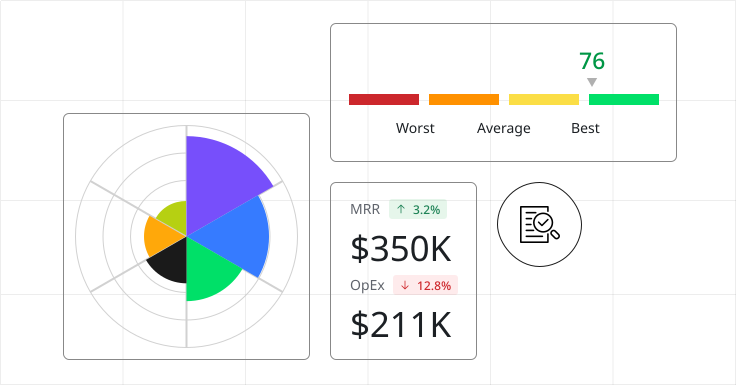
Portfolio Risk Scoring with Account Manager
Insurers can analyze and quantify the risk quality of any portfolio to distinguish one from another for portfolio optimization and risk monitoring. Dissect your portfolio and identify problem accounts, industries, and peer groups based on select at-risk telemetry.
Capability overview
- Identify the key drivers of risk and profitability within your portfolio
- Generate a custom view of accounts and their ranks within your portfolio*
- Easily generate portfolio optimization analyses for annual tiering exercises
- Demonstrate underwriting discipline and rigor for reinsurance discussions
SPoF Intelligence
Identify Single Points of Failure (SPoFs) within portfolios and manage your risk concentrations to help minimize cyber catastrophe losses across all coverage types.
Capability overview
- View technology dependencies in your portfolio
- Understand and manage your digital supply chain risk accumulations
- Improve claims response to cyber events.
Industry Exposure Database (IED)
CyberCube’s Industry Exposure Databases (IEDs) are the world’s first set of detailed cyber-exposure databases, providing foundations for the only industry-accepted industry loss curves.
Capability overview
- Analyze potential growth strategies
- Perform real-time event analyses and sensitivity analyses
- Create proxy portfolios for planning purposes, reinsurance, or ILS transactions
- Validate models and manage model changes and conduct industry benchmarking analysis
Frequently Asked Questions (FAQs)
-
Exposure Manager gives reinsurers an independent, data-driven view of the underlying risk quality within a cedant portfolio. It helps normalize treaty portfolios, compare treaty risk quality, identify outliers, and assess whether the cedant’s underwriting narrative is reflected in the data. Reinsurers can evaluate security posture, exposure characteristics, risk segments, and changes in portfolio quality over time. This supports treaty underwriting by adding objective cyber risk analytics to the traditional review of terms, conditions, loss experience, and cedant strategy. The business value is clearer treaty selection, stronger pricing discipline, and more constructive renewal conversations with cedants.
-
Exposure Manager is built for both reinsurers and insurers, with use cases that reflect how each makes cyber risk decisions. Reinsurers can use it to evaluate cedant portfolios, compare treaty submissions, benchmark risk quality, and support pricing and renewal discipline. Insurers can use it to monitor portfolio health, assess underwriting strategy execution, manage global books, and oversee MGA or delegated authority relationships. In both cases, the platform turns granular single-risk analytics into portfolio intelligence that supports practical insurance decisions. This makes Exposure Manager useful wherever teams need clearer visibility into cyber portfolio quality, underwriting discipline, and risk accumulation.
-
Exposure Manager provides a centralized way for insurers to monitor cyber portfolio quality across growing books, global portfolios, and MGA or delegated authority partnerships. It helps teams assess whether underwriting strategy is being followed, where risk is changing, and which segments may require closer review. Underwriters and portfolio managers can compare performance across business units, regions, industries, and account cohorts using consistent risk measures. This makes it easier to spot drift from appetite, identify risk concentrations, and guide underwriting adjustments before issues become embedded in the book. The outcome is more consistent underwriting and stronger portfolio resilience at scale.
-
Exposure Manager supports pricing by giving underwriters and portfolio teams a clearer view of cyber risk quality at both the account and portfolio level. Its exposure and security scoring framework helps differentiate risks based on inherent exposure, technical resilience, incident history, technology indicators, and other insurance-relevant signals. Teams can benchmark portfolios or bordereaux against peers, internal segments, or custom views to understand relative risk quality and marginal impact. This helps pricing discussions move beyond broad assumptions or inconsistent submission narratives. The value is greater cyber insurance pricing confidence, stronger risk selection, and a more defensible view of price for risk.
-
Exposure Manager helps teams test underwriting narratives against objective risk signals and portfolio benchmarks. Reinsurers can assess whether a cedant’s stated strategy, risk quality, or year-over-year improvement is visible in the underlying data. Insurers can use the same approach to evaluate internal underwriting execution across teams, regions, or delegated authority partners. The platform supports deeper reviews by segment, such as industry, company size, attachment point, or portfolio cohort, making it easier to identify where the narrative holds and where additional discussion is needed. This creates more constructive conversations and supports defensible decisions around treaty renewal, pricing, appetite, and remediation.
-
Exposure Manager is built to fit into real cyber underwriting and portfolio workflows through both an interactive user interface and API-based integration. Teams can use it during new treaty or renewal underwriting, submission review, analysis, pricing, contracting, mid-term audits, and insurer-reinsurer collaboration. Smaller teams can work directly in the platform, while larger organizations can connect XM insights into internal systems for faster, repeatable decisioning. This flexibility helps underwriting, portfolio, actuarial, and reinsurance teams use a consistent view of risk without forcing a major workflow redesign. The value is faster adoption, stronger governance, and scalable cyber insurance workflow alignment.
-
Exposure Manager puts you in the control center of your cyber portfolio. It gives teams a common analytical framework for assessing cyber portfolio quality across markets, regions, cedants, and underwriting groups. Instead of relying on inconsistent local interpretation or manual analysis, teams can use consistent scores, benchmarks, and risk signals to evaluate accounts and sub-portfolios in a repeatable way. This supports more consistent underwriting decisions while still allowing teams to account for local market context and strategy. For leaders managing global underwriting at scale, Exposure Manager helps identify where underwriting approaches are aligned, where drift may be occurring, and where governance attention is needed. The outcome is stronger consistency without losing underwriting judgment.
-
Exposure Manager is designed for rapid onboarding and flexible deployment, with options for direct platform use or API-based integration into existing underwriting environments. Teams can begin exploring portfolio quality, benchmarking submissions, reviewing risk segments, and identifying areas for underwriting action without waiting for a lengthy systems transformation. The platform’s click-to-explore interface supports fast investigation, while integration options help larger organizations scale insights across established workflows. This helps insurers and reinsurers move from raw portfolio data to actionable cyber risk analytics quickly. The business value is faster time to insight, earlier underwriting impact, and more scalable portfolio decision-making.
-
Exposure Manager helps insurers and reinsurers assess cyber portfolio health by translating account-level risk metrics into clear portfolio-level insights. It combines firmographic, technographic, policy, and cyber risk data to show how risk quality varies across segments, cedants, industries, geographies, and underwriting cohorts. Teams can explore scores, signals, and benchmarks interactively rather than relying only on static bordereaux reviews or subjective narratives. This gives portfolio, underwriting, actuarial, and reinsurance teams a shared view of where risk is improving, deteriorating, concentrating, or diversifying. The result is more disciplined portfolio risk management and more defensible decisions about pricing, renewal strategy, and growth.
-
Exposure Manager helps normalize comparisons across portfolios with different compositions, including differences in industry mix, company size, geography, attachment, policy count, limit, premium, and other underwriting dimensions. It allows teams to look beneath headline premium or exposure figures and compare the underlying risk quality of two books, treaties, or segments. The platform can highlight which parts of a portfolio are driving higher or lower risk and where a submission deviates from expected baselines. This helps insurers and reinsurers avoid treating superficially similar portfolios as equivalent. The result is more precise risk selection, clearer pricing rationale, and better-informed portfolio steering.